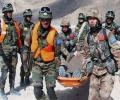
The day-long exercise held "is part of the ongoing initiatives being taken by India and China to ensure greater interaction between troops stationed along the Line of Actual Control.

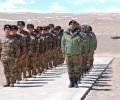
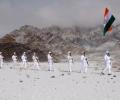
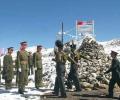
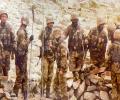
It was a scene of bonhomie as the border personnel of India and China met to mark the Republic Day in Chushul belt along the Line of Actual Control in Ladakh, putting behind the tension over recent incursions by the People's Liberation Army in the area.

India is looking forward to a "constructive" dialogue with China to resolve issues in remaining friction points in eastern Ladakh, sources in the security establishment said on Monday ahead of the 14th round of military talks between the two sides on the 20-month row.

India and China on Friday are holding another round of high-level military dialogue to resolve the 22-month-long standoff in some friction points in eastern Ladakh, two months after the last round of such talks failed to yield any significant outcome.
The two sides agreed that the next round of military dialogue should be held at an early date.
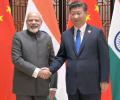
Two days ago, the Chinese foreign ministry following a meeting between NSA Ajit Doval and top Chinese diplomat Wang Yi in Johannesburg claimed that Xi and Modi had reached an 'important consensus' on stabilising bilateral ties at the interaction on the margins of the G20 Summit last November.
The Sichuan-Tibet Railway will be the second railway line into Tibet after the Qinghai-Tibet Railway project. It will go through the southeast of the Qinghai-Tibet Plateau, one of the world's most geologically active areas, according to the Chinese official media.
Yes, we (Quad) had a discussion on India-China relations because it was part of how we briefed each other about what was happening in our neighbourhood, Jaishankar said.

Xi asked about their condition and whether they were able to "receive fresh vegetables" in the inhospitable terrain.
The Indian side forcefully pressed for early resolution of the standoff and particularly insisted on expeditious disengagement in Hot Springs and Gogra, a source said.

The two sides have also agreed for a joint mechanism to verify the progress in the disengagement process through delegation meetings as well as using unmanned aerial vehicles.

The meeting started at around 11.30 am at Moldo on the Chinese side of Line of Actual Control (LAC) opposite Chushul to defuse the tensions in Eastern Ladakh sector due to Chinese military build-up, the sources said. This is the second meeting between the two corps commanders.

After a gap of over three months, India and China on Wednesday are holding another round of high-level military talks to resolve the 20-month-long military standoff in the remaining friction points in eastern Ladakh, sources in the security establishment said.

Glimpses from Yudh Abhyas, the India-US military exercise currently being conducted in Tapovan, Uttarakhand, 100 km away from the Line of Actual Control.

The move comes amid hectic diplomatic manoeuvring between the two countries over a host of issues like Nuclear Suppliers Group and designation of Masood Azhar as a terrorist by the United Nations.
'I strongly urge China to respect norms and use diplomacy and existing mechanisms to resolve its border questions with India'
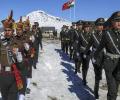
The disengagement plan was discussed between the two sides during the 8th Corps Commander-level talks which were held on November 6 in Chushul.
The Chinese and the Indian troops were engaged in a standoff for 73 days in Doklam.

'Given China's past behaviour and their territorial claims, should we be sceptical regarding China's willingness to adhere to these agreements fully? The answer is yes.' 'As Ronald Reagan famously said in the context of the SALT talks, 'Trust, but verify!' India should also do the same.' 'This has already begun with foot patrolling, drones, satellite imagery and so on. India's military deployment did mirror China's and will continue to do so in the future.'
According to the government sanction, the fresh manpower will be utilised for manning 47 new border posts and a dozen 'staging camps' or troops bases along this frontier.
There was no official word on the outcome of the talks.

Situated at a height of 15,200 feet above sea level, the pass sits on the top of a craggily formed Himalayan range that separates the Tibetan plateau from the Indian sub-continent.
China on Wednesday said the latest round of the border talks with India was held in a "candid and pragmatic atmosphere" and the two sides had a "positive, constructive and in-depth discussion" on the resolution of the remaining issues along the Line of Actual Control in the Western Sector.

The heightened state of alert was only relaxed after Wang met his Jaishankar in Moscow on Friday on the sidelines of the Shanghai Cooperation Organisation summit, a second source said.
General Officer Commanding-in Chief of the Eastern command, Lieutenant General R P Kalita, however, said the Indian side is also continuously upgrading its infrastructure and capabilities to deal with any situation which may arise along the border.

'It's a very tough situation. We're talking to India. We're talking to China. They've got a big problem there'

The Indian Army has released photos and videos of its soldiers playing cricket at a very high-altitude forward location in eastern Ladakh amid the lingering border row with China along the Line of Actual Control (LAC) in the region.

China said that after this incident both sides are in communication and coordination on the matter through diplomatic and military channels.
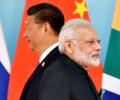
'The events of 2020 have actually put our relationship under exceptional stress.' What External Affairs Minister Dr Subrahmanyam Jaishankar told the All India Conference of China Studies on Thursday, January 28, 2021.
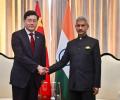
He alleged that India "lost access to 26 out of 65 Patrolling Points" which was not the case before May 2020, and questioned the Modi government's "silence" on the issue.

"China's position on the Zangnan region (South Tibet) is consistent and clear. We never recognised the so-called Arunachal Pradesh," Chinese Foreign Ministry spokesperson Hua Chunying told a media briefing while responding to a question.
The international community must be clear that such a behaviour is unacceptable, a top US senator said.

Until Delhi and Beijing resolve outstanding border issues within an accelerated time frame, standoffs like Doklam will be repeated across various peaks along the Himalayas, says Mathew Maavak.
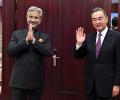
China is ready to take "conciliatory steps" in order to avoid new violations of the obligations on the India-Chinese border, Chinese Foreign Minister Wang Yi said on Friday, a day after holding a crucial meeting with External Affairs Minister S Jaishankar over the current standoff in Ladakh. Speaking during a joint press conference with Russian Foreign Minister Sergey Lavrov, Wang said troops and equipment should be withdrawn from the Line of Actual Control (LAC).
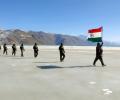
Indian troops are defending every inch of the border with China and not even a single inch of land has been taken over by the neighbouring country in recent years, Ladakh Lt Governor Brig (retd) B D Mishra said on Thursday.
India on Monday pressed for early disengagement of troops in remaining friction points in eastern Ladakh during a fresh round of high-level military talks with China, people familiar with the matter said.

China routinely objects to Indian leaders' visits to Arunachal Pradesh to buttress its stand.
The sources said both sides held extensive deliberations on modalities for disengagement of troops from all the friction points in eastern Ladakh at the talks.

'My understanding is that by the time President Xi Jinping came for the Chennai summit [2019], he had already instructed his army to undertake the action in Galwan in the summer of 2020.'
Jaishankar said China, in violation of the 1993 and 1996 agreements not to mass troops on the Line of Actual Control, chose to do so, and added that its attempt was obviously to unilaterally change the LAC.
 © 2026 Rediff.com - Advertise with us - Disclaimer - Privacy Policy - Sitemap - Feedback - About us - Terms of use - Grievances